Skip to content

Audio

Audio is both a craft and a signal.

For voice and audio teams whose product has to survive real rooms, real noise, and real use.

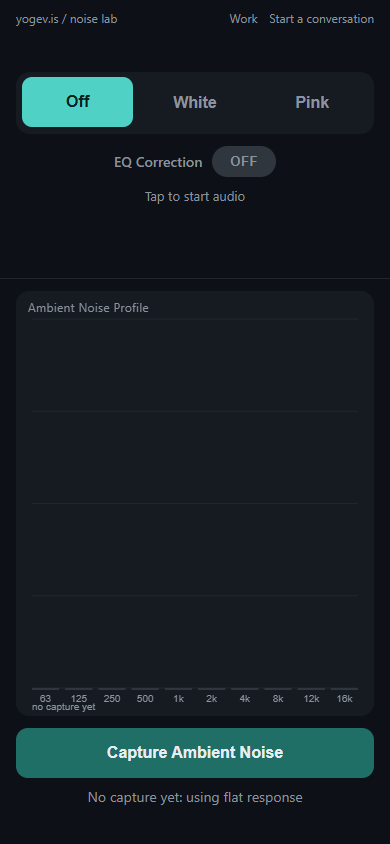
Mobile view of the live Noise lab with white and pink noise controls, ambient noise profile, and capture action
The live Noise lab, captured on mobile.

Studio practice and the physics underneath it.

In the studio

My practice spans audio engineering, music production, vocal production, mixing, and mastering.

I have produced music for more than 20 years, with published tracks and press interviews. I trained formally at BPM College, play drums, keys, and guitars, run Psyberspace Networks, and co-managed OffStream Records.

In engineering

I hold dual BSc degrees in Physics and Electrical & Electronics Engineering, plus an MSc in Electrical Engineering focused on AI, ML, computer vision, data science, and signal processing.

I work across one-dimensional time series, two-dimensional images, and multidimensional sensor data. The recurring questions are sampling, filtering, noise, representation, inference, and validation.

I once listened for rain in microwave data.

My MSc project used cellular microwave links as a distributed rain sensor. I applied graph spectral methods and random forests to attenuation time series, then evaluated the results against Israeli Meteorological Service radar data.

The way I experienced that work was almost auditory. After gating the attenuation data for noise reduction, I practically listened for rain in the time series. The medium was microwave data, not sound. The pattern-recognition instinct was the same.

Find the event. Remove what masks it. Test whether the signal survives outside the clean example.

The feature is not the product. The operational envelope is.

Voice AI can look excellent in a quiet demo and collapse in a car, an open office, or a crowded room.

This is a personal field observation from August 2026, not a controlled benchmark or a universal leaderboard. In my own daily use, ChatGPT voice stayed usable for me in ambient noise where Gemini did not, while Wispr Flow, which I use and value, became impractical on a bus. Those results will move with the next release. The requirement underneath them will not.

Better speaker isolation and noise reduction matter. So do hardware designed for quiet, close delivery and multimodal cues from a camera that can see the speaker's face. Those extra signals are often already available on the device. The product work is making them fit the same latency, privacy, and power budget as audio-only input.

Read the LinkedIn discussion

Where I am most useful

Audio and voice product teams
Product framing, noisy-world evaluation, speaker isolation, and explicit tests for the operational envelope. I define the protocol, run it, and return a pass/fail envelope with a ranked fix list.
Signal analysis and ML
Time-series preprocessing, one-, two-, and multidimensional signal analysis, audio processing, AI, ML, and evidence design that an engineering team can rerun.
Cross-disciplinary R&D
A working bridge between musicians, audio engineers, signal-processing teams, ML researchers, product leaders, and founders without losing the signal between disciplines.
Records and performances
Audio production, vocal production, mix decisions, mastering perspective, and a producer's ear for what the work is trying to become. This craft is the foundation beneath the product work above.

How this usually starts

Operational-envelope review
A scoped evaluation under real conditions. You get a rerunnable test protocol, a findings memo, and a ranked list of what to fix.
Fractional product leadership
Ongoing product ownership for an audio, voice, or signal-heavy team that needs roadmap judgment and evidence design in the same chair.
Advisory and second opinion
A standing line for founders and technical leads deciding what to test, what to build, and whether the result is ready to trust.
Production collaboration
Project-based audio production, vocal production, mix and mastering work for records and performances that benefit from an engineer's ear.

A live experiment: adaptive spectral noise masking

The Noise lab listens to ambient sound locally, then shapes white or pink noise around the room's spectrum. Microphone analysis stays on the device.

It is a small, honest proof for a larger question: can masking noise respond to this room instead of treating every room as identical? It does not claim to solve speaker isolation or voice-AI robustness.

Open the Noise lab

If noise, audio quality, or signal interpretation decides whether your product works, tell me what you are up against.

Send the product, the failure mode, and whether you want a review, a production collaboration, or a longer engagement.

Start a conversation